Showing posts with label Battle of the Atlantic. Show all posts

Monday, May 11, 2015

Battle of the Atlantic Dinner

The 70th anniversary of the end of the longest battle of the Second World War, the Battle of the Atlantic, was celebrated at HMCS Discovery, Vancouver's reserve naval base, on May 2nd.

Present and pictured at left as Guest of Honour was The Honourable Judith Guichon, OBC, Lieutenant Governor of British Columbia. Brian Cook, president of the Naval Officers Association on BC was mess president for the occasion. At left, the Lieutenant Governor was presented with a history of Discovery.

To the right are John Horton (left), prominent marine artist, and Dr James Boutilier, Special Advisor to Commander MARPAC (Maritime Command Pacific, RCN). Dr. Boutilier spoke about the Battle of the Atlantic, and drew attention to the appalling losses suffered by the German U-boat fleet during the battle.

Wednesday, May 7, 2014

The Battle of the Atlantic

Seventy-one years ago this month marked a turning point in the Battle of the Atlantic.
Slow Convoy 130 sailed from Halifax for Liverpool, escorted by ships of the Royal Canadian Navy. Up to that time, slow convoys had been easy pickings for U-boats of the Kriegsmarine, though less so with allied advances in equipment and technology.

A turnover of escort duty was duly made to a Mid-Ocean Escort Group, aided by long-range patrol aircraft. Three waves of German submarines were vectored onto SC 130, but every ship of the convoy made it safely across the Atlantic. German losses to aircraft and ships were at least three submarines with others damaged.

The month termed "Black May" by the German submariners was the pivotal point in World War II's longest-running battle.

HMCS Sackville, Canada's last surviving corvette, one of the many small ships of the RCN and RN that were a major force in the Battle of the Atlantic. Sackville is on display in Halifax and is a crucial piece in a major planned Battle of the Atlantic museum.

Monday, May 5, 2014

Battle of the Atlantic at HMCS Discovery

I was honoured to be the speaker at the Naval Officers Association of British Columbia's annual Battle of the Atlantic dinner held on May 3rd at HMCS Discovery. Discovery is the Canadian navy's reserve division headquarters in Vancouver.
Some sixty-five or so members and guests attended. The attendees enjoyed a fine meal and interesting company, with ship's officers leading the way in impromptu renditions of "Heart of Oak" and "What Shall We do with a Drunken Sailor".

Following the formal parts of the dinner I presented a brief overview of Canadian submarines and submariners, tracing back from the present-day Victorias to CC1 and 2. In the photo above, taken during my talk, it was fortuitous that a new painting of CC1 and CC2 by our very accomplished marine artist, John Horton, was on display. It is visible in the background.

Also present were John Molyneux and his grandson, Philip. John is a long-standing member of the NOA of BC. In the photo they are in front of a painting of HMS Hood during a visit to Vancouver between the wars. John had the distinction of serving in Hood--and the good luck to be drafted off scant weeks before she sailed on her final voyage and her fatal meeting with Germany's Bismarck.

Photos courtesy Mary Horton

Thursday, March 13, 2014

HMCS Okanagan lives on--remnants and memories

This happy gentleman is George Cruickshank, proprietor and head tour guide at the Museum of the Battle of the Atlantic, located in Duncan, BC.
I recently made a thrilling visit to George's museum. He has hundreds of artifacts from Allied and German submarines and ships, uniforms, etc.
One room is partitioned off, and accessible only through a Fleet Boat-sized doorway.


Inside it are George's most valued Canadian submarine pieces, including this gorgeous clinometer salvaged from HMCS Okanagan, the last-built Canadian Oberon-class boat. She lives on in the memories of her crew, and is brought to life by George's enthusiasm.

Check out the museum here: www.thebattleofatlanticmuseum.ca. 

Thursday, May 23, 2013

Canadian Naval History, courtesy of the National Film Board of Canada

HMCS Bonaventure
Thanks to a mention in the newsletter of a naval organization, I saw a reference to a 1960 National Film Board movie. Fifty-eight minutes in length, An Enduring Tradition presents in a remarkably cogent fashion the history of the Royal Canadian Navy up to 1960. Aircraft carriers, cruisers, destroyers, frigates, corvettes, submarines, minesweepers, auxilliaries: they are all there.
RCN names to conjure with: Charles Kingsmill, Walter Hose, Harry DeWolf, and many others. "Heart of Oak" and "Roll Along Wavy Navy". Shiploads full of inherited memories, and real ones, diminished by time, stirred up.

Friday, May 10, 2013

Battle of the Atlantic marked at HMCS Discovery

Dr Boutelier (left) accepts "Soldier of the Horse"
HMCS Discovery, along with the Naval Officers Association of British Columbia, marked the Battle of the Atlantic with a mess dinner on May 4th. Keynote speaker was Dr James Boutilier, historian and author, who is Special Advisor ( Policy) to Maritime Forces Pacific Headquarters in Esquimalt.
Dr Boutilier spoke about the sacrifices made by the Allies as well as enemy submariners in the Atlantic in World War II. He noted the continued threat to the free world by proliferating submarine fleets in the Pacific today.
Dr Boutilier was presented with a copy of Soldier of the Horse by the author, whose brother and sister both served in the RCN during the Battle of the Atlantic. (Photo courtesy Mary Horton)

Friday, May 3, 2013

World War II's Longest Fight--The Battle of the Atlantic

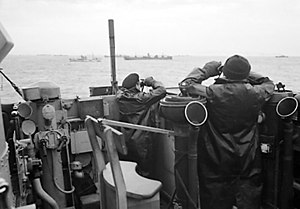
Officers on the bridge.jpg
The bridge of a British escort

The Battle of the Atlantic ran from the outbreak of World War II in 1939 until the German surrender in 1945. It pitted the Germans on one side against primarily the British and Canadian navies on the other. At stake was the blockade of German ports by the Allies, and the blockade by the Germans of shipping to the UK and Russia. It was a near-run thing for the Allies, with the balance of success shifting one way or the other with technical advances often a determining factor. Radar, air cover, and code-breaking all played a part in the Allied victory.
But at the heart of the victory were the merchantmen running the deadly U-boat wolfpacks, escorted by the little ships of the Royal Canadian Navy and the Royal Navy.
There are fewer survivors of the longest battle of the war still with us every year. This weekend is dedicated to them. Church ceremonies, dinners, naval and Legion observances are the order of the day. Please attend, or spare a thought for the men and women who defended us all through those dark days. (photo courtesy Wikipedia)

Tuesday, July 24, 2012

Canadian Submarine Sinks a Ship


HMCS Victoria, one of Canada’s four deisel-electric submarines, is currently taking part in RIMPAC 2012, a major multinational military exercise out of Hawaii. As part of her contribution and training, Victoria got to perform a “Sinkex”, which is just what it sounds like—she sank a surface ship.

The victim was the former USNS Concord, 18,000 tons, stripped and prepped for disposal.

For a look at the shocking power of a single torpedo fired by Victoria, see this site and follow the links:


The video is a brutal reminder that a single submarine has the potential to cause untold havoc on shipping. It is hard to imagine the enormity of the job faced by Allied forces during the Battle of the Atlantic, when the RCN, among others, faced the German U-boat blockade. It is equally hard to imagine the bravery of the men manning unarmed merchant ships in those cruel waters.