Showing posts with label War Horse. Show all posts

Tuesday, November 25, 2014

War Horse: The Real Story


 A friend kindly invited me to look at a television production he had recorded, called "War Horse: the Real Story".
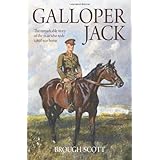
Product DetailsThe show was interesting, but quite superficial in spite of having had contributions by experts such as Brough Scott and Dr. David Kenyon.
Brough Scott is the grandson of Brigadier Jack Seely, who commanded the Canadian Cavalry Brigade through most of World War I. Scott wrote "Galloper Jack", about his grandfather.
Dr Kenyon is a historian and notable author of "Horsemen in No Man's Land", a rexamination of the effectiveness of cavalry in the Great War.
I commend both books to anyone interested in the Canadian cavalry and the British cavalry in general.

"War Horse: the Real Story" was a sanitized version of the story of Warrior, Seely's charger during the conflict and after. Obviously meant for an English audience, it only mentioned in passing that Seely's main (but not only) claim  to fame was his leadership of the Canadian Cavalry Brigade.

Here are some earlier thoughts about the movie "War Horse", Spielberg's 2011 production.

Monday, August 4, 2014

"Soldier of the Horse" at the VPL

As predicted, last Wednesday the 30th of July was a busy one. I was interviewed briefly on The Early Edition on CBC Radio, then attended an afternoon showing of "War Horse", Spielberg's movie adaptation of Michael Morpurgo's novel.

That evening, I spoke in the Alice MacKay room of the main branch of the Vancouver Public Library. My topic was Soldier of the Horse, the first public presentation regarding my first novel in some time.

The event was a joint effort by the VPL and the Vancouver branch of RUSI, the Royal United Services Institute. At the left in the photo is RUSI president Cameron Cathcart, a former CBC reporter and great advocate of the need to celebrate our military history and remember the sacrifices of so many.

More RUSI events to mark the 100th anniversary of the outbreak of the Great War will be featured at the Vancouver Public Library.

Tuesday, July 29, 2014

Navy Woes and Cavalry Stories

Tomorrow, July 30th, will be a busy day for Soldier of the Horse.
The good people at The Early Edition on CBC Vancouver have invited me to attend for an interview at 7:50 am tomorrow (0750 for present and former RCN readers, 0750 hours for all you army types out there). The occasion is a Vancouver Public Library/Royal United Services Institute initiative: the showing of the movie "War Horse" at 1:30 pm, same day, at the VPL. Later, at 7:00 pm I'll be speaking in the library about my father's time in the Canadian cavalry in the Great War and Soldier of the Horse.
My talk is the first of four scheduled in the VPL to mark the 100th anniversary of the start of World War One.

In the meantime, across the Pacific, the huge naval, land, and air exercise RIMPAC 2014 continues. But the Royal Canadian Navy finds itself short of seagoing ships. Our submarine Victoria is there, along with frigate HMCS Calgary and minesweeper HMCS Nanaimo (she is in California waters, as opposed to the central Pacific/Hawaii).
Missing in action are HMCShips Algonquin (destroyer, rusting out),  Protecteur (fire damaged supply ship), and minesweeper Whitehorse (bad behavior by members of the crew). You have to sympathize with navy personnel who in typical Canadian fashion carry on with less. Less money, less fuel, lesser numbers of ships. One has to wonder who will protect Canadian interests at sea in case of need.

Monday, July 21, 2014

War Horse meets Soldier of the Horse

The photo at left was taken by a helpful bystander earlier this year in the lobby of the Queen Elizabeth Theatre in Vancouver. Nattily attired with my submarine tie no less, I had just attended a performance of the stage play "War Horse". It was an emotional experience for me, given my father's time in the Canadian Cavalry Brigade.
My novel "Soldier of the Horse" based on the experiences of Sergeant Thomas Mackay of Lord Strathcona's Horse (Royal Canadians) was published a couple of years ago. On July 30th, just nine days from now, I will be attending a showing of the movie "War Horse" at the Vancouver Public Library at 1:30 pm.
Later that evening at 7:00 pm I'll be presenting in the Library, thanks to the good offices of the VPL and the Royal United Services Institute.
Here is the information from the VPL website:


"Robert W. Mackay, author of Soldier of the Horse, shares personal photos, memories and insights into the Canadian Cavalry Brigade of which his father was a member.
"War Horse", a movie about the British cavalry in the Great War, has many powerful images of horses and men in battle. A small but significant part of the British cavalry was the Canadian Calvary Brigade. Did the movie reflect reality?
Presented in partnership with The Royal United Services Institute - Vancouver in commemoration of Canada's First World War Centenary.
For more information please contact: Programming and Learning Services at info@vpl.ca at 604 331-3603"

Monday, September 30, 2013

"War Horse" in Vancouver

I was excited to see "War Horse", the stage adaptation of Michael Morpurgo's novel. What makes the play unique is the fact that the central character is Joey, a horse, who goes to war with the British cavalry in 1914. Brought to life by the amazing puppets that play the horses, as designed by the Handspring Puppet Company of South Africa, the horses steal the show. They buck and rear, they snort, and they gallop--straight toward the audience in a sequence that transports watchers to the bitter fields of artillery-torn France.
There are explosions and gunfire aplenty, and a strong scene where Joey is caught on the wire in No Man's Land. The novel was written for young readers and comes with a Hollywood ending, with many a tear trickling down cheeks in the Queen Elizabeth Theatre.
The performance I attended was a matinee, so I wondered for a while if there might not be school children attending, but that was not the case. There was an awful lot of grey hair on display, with most members of the audience middle-aged or older. Too bad, as there is lots in the story to hint at some of our at times bloody history.

To read my prize-winning novel about real war horses, and the men that rode them, see "Soldier of the Horse" here.

Friday, February 22, 2013

The Canadian Cavalry in the Last 100 Days (Part 3)


One of the Canadians caught up in the 2nd Battle of Le Cateau was S. H. Williams, author of “Stand to Your Horses”. He was temporarily attached to the 6th Brigade, and watched while two British regiments went at full gallop across an open stretch of land some 2,000 yards long, where there was no cover for man or horse. They were being shelled by the Germans, and in the midst of it a flight of “aeroplanes, which I took to be ours until their actions proved them to be enemy,” attacked from the air. Williams’ assessment of the situation was that it made for an “exciting few moments”. In his view, though, in that particular incident the guns and aircraft didn’t do more damage than hitting a few men and horses, due to the speed of their gallop. Probably not enough to ruffle the feathers of Williams, a tough officer who had been through four years of war by this time.

Thursday, July 26, 2012

Painting of a Canadian Trooper

Here is a copy of an iconic painting entitled "Soldier, Lord Strathcona's Horse, 1918". It is by Ron Volstad, courtesy, Department of National Defense.
The painting illustrates the equipment carried by a WW I Canadian trooper and his horse. Note the leather "wallets" on the front of the saddle, the .303 Lee Enfield in its bucket, and the 1908 Pattern sword. (Readers of "Soldier of the Horse" will know why the wallets are important.)
Both horse and rider carry ammunition.
An unencumbered cavalry saddle of the day (see below) would have been hard to hang onto, in the case of a rambunctious charger; but, once loaded down with standard gear, probably as hard to fall off of as any western saddle.


This photo was taken by the author at the The Military Museums in Calgary

Wednesday, April 18, 2012

Galloper Jack and the Canadian Cavalry Brigade ( Part 2)

During the prewar years of the 20th century, Jack Seely's career soared to amazing heights. Although a Conservative, he crossed the floor of the house and sat as a Liberal. He ultimately achieved cabinet status as Under-Secretary of State for the Colonies, Under-Secretary of State for War, Privy Councillor, and in 1912 became Secretary of State for War.
Seely was most proud of his time in the latter position, encouraging the development of the Royal Flying Corps; inviting General Foch of the French army to attend British army manoeuvres; and observing German manoeuvres with the Kaiser. There is no doubt he anticipated World War I and did his best to prepare Britain's forces for it.
As a result of the Curragh Mutiny, for which he was unfairly blamed, Seely was forced to resign from the cabinet on March 30th, 1914. He little dreamt that precisely four years later he would face his hardest, and finest, hour.

Tuesday, April 10, 2012

"War Horse" Images

The novel War Horse, followed by the play and movie of the same name, has sparked much interest in the activities of British and Commonwealth cavalries in World War I. Michael Morpurgo's novel had plenty of inspiration to draw on for its battle scenes, from early cavalry charges in 1914, through the desperate fighting at Moreuil Wood by the Canadian Cavalry Brigade, and the last 100 days of the war.
Popular images of cavalry charges, with well-organized lines of mounted men sweeping into battle, were reinforced by such paintings as "The Charge of Flowerdew's Squadron" by Sir Alfred Munnings. (For a look at that painting, see my website.) The reality was much different. Indeed, the cavalry continued to be decimated up to the final days, whenever machine guns and artillery were ready and waiting for them.