Showing posts with label Royal Canadian Navy. Show all posts

Friday, October 9, 2015

A Second Location


It's very gratifying to see my "Forces With History" blog continues to attract attention, even though I'm now blogging on a regular basis on a new site, where my blog is integrated with my website.

A direct link to my new blog will take you straight there.

I'm continuing to publish a newsletter, also called "Forces With History", that comes out every three weeks or so. It deals with defence topics, the navy, submarines, and anything in the general area that catches my eye. To receive it, just send me an email at bob.mackay@hotmail.com, or telephone 778-388-1009.

Saturday, December 27, 2014

USS Ranger--Proud Ship Scrapped For a Penny

 The year I believe was 1964, and Her Majesty's Canadian Ship Ottawa (2300 tons) was fuelling off USS Ranger (66,000 tons). Ranger's career was from 1957 to 1993, and Ottawa's an almost identical 1956-1992.
The Ranger is now on her way to the scrap-heap, after attempts to turn her into a museum piece failed. She was one of four Forrestal-class supercarriers, and saw service in Vietnam, the Middle East, and elsewhere. As you can see from the "60" yard marker, Ottawa is getting squeaky close to the larger ship (the other end of the line is attached to Ranger).
We never knew how much we were tossed about in even these moderate seas until we were close to a rock-solid behemoth such as Ranger.


In this snapshot, also taken on Ottawa's bridge, as very junior sublieutenant I have as a backdrop Ranger pulling away, flanked by two  destroyers.


Thursday, November 20, 2014

Venerable Sea Kings a Testament--and a bigger embarrassment

My friend Dave Critoph sent me the image at left. It speaks for itself--it's the cover of a booklet celebrating 50 years of service by the Sea Kings on behalf of the Royal Canadian Navy.
Dave flew Sea Kings in 1966 from our last aircraft carrier, HMCS Bonaventure, during Maple Spring 66, a major exercise that covered the seas from Halfiax to Monetevideo. I was there too, watching the state-of-the-art Sea Kings do their stuff.

Fifty years of service. That they are still able to fly at all is a testament to the skill of their maintainers and aircrew. Back in 1966, I recall being shocked at the number of hours maintenance it took for every hour of flight--10 or 20 perhaps. What would it take now to keep these magnificent birds in the air for an hour--a hundred?

You might think the Sea Kings should have been replaced by now. You would be right. The defence department in the Mulroney era would--and did--agree with you. Jean Chretien, of course, couldn't countenance a Mulroney plan so he cancelled the order, resulting in a $500 million penalty.

Since then the Canadian government, and Canadian Forces, have not been able to get their act together. I couldn't put it better than did military historian Aaron Plamondon as quoted in an article in the National Post by Andrew Coyne: that the Sea King replacement saga is quite possibly "the most poorly executed military procurement ever undertaken--anywhere." Forty years after the need for a replacement helicopter was called for, the Sea Kings remain, albeit most of the time on the ground.

Monday, October 13, 2014

Submarines on Many Minds


Here is the scene in the National Arts Centre, Ottawa, on October 2nd.

More than 200 attendees at the Naval Association of Canada's conference themed "Canada's submarines: past, present and future" heard authoritative speakers and took part in discussions.

Topics ranged from history (1914's CC1 and 2) through to the state of today's Victoria-class boats.
The afternoon session focussed on the topic of eventual replacements given today's tight federal budgets, as well as the experience of the Australian submarine program.

Wednesday, September 3, 2014

Fifteen Diesel-electrics All in a Row (or eight)

In my soon-to-be-available submarine thriller, "Terror on the Alert", my main character notes a buildup of Royal Navy submarines in their home ports during the leadup to the Cuban Missile Crisis.

This photo was kindly provided by Ed Falstrem, who like me trained with the RN and served in A-boats. He says:

"Here is a photo of 15 RN submarines alongside the depot ship taken in Oct 1962, just as the Cuban crisis was developing."

Ed, who went on to command four Royal Canadian Navy boats, had this to say about "Terror on the Alert":

I have read the book and enjoyed it very much. I could argue with you over a couple of technical details but it sure took me back to my time on Acheron and Aeneas.

Monday, September 1, 2014

"It's Not the Ships...My War Years"--A Review

"It's not the ships, it's the men in them" was Fredrick H. Sherwood's favourite maritime adage, and the first words of that saying make for the perfect title to this memoir.
Freddie Sherwood, as he was known to his comrades and successors in submarines, was a much-decorated Canadian submariner who achieved a number of World War II firsts: first nonBritish officer in an RN boat, first volunteer reservist to command an RN boat, first Canadian to command an RN boat.
In reading this memoir I had the feeling of being in the company of a fine man, a born leader, and a meticulous but funloving submarine captain. The key to Sherwood's success was his ability to meld his crew into a unified team, and he took great pride in his ship's company, ensuring they got the recognition they deserved. From training days through service under a renowned RN captain, and on to his command of two submarines in the North Sea and the Far East, Freddie Sherwood's wartime story is a great read. Highly recommended.

"It's Not the Ships...My War Years" was edited and published by Freddie's son Philip. More information is on the web.

Tuesday, July 29, 2014

Navy Woes and Cavalry Stories

Tomorrow, July 30th, will be a busy day for Soldier of the Horse.
The good people at The Early Edition on CBC Vancouver have invited me to attend for an interview at 7:50 am tomorrow (0750 for present and former RCN readers, 0750 hours for all you army types out there). The occasion is a Vancouver Public Library/Royal United Services Institute initiative: the showing of the movie "War Horse" at 1:30 pm, same day, at the VPL. Later, at 7:00 pm I'll be speaking in the library about my father's time in the Canadian cavalry in the Great War and Soldier of the Horse.
My talk is the first of four scheduled in the VPL to mark the 100th anniversary of the start of World War One.

In the meantime, across the Pacific, the huge naval, land, and air exercise RIMPAC 2014 continues. But the Royal Canadian Navy finds itself short of seagoing ships. Our submarine Victoria is there, along with frigate HMCS Calgary and minesweeper HMCS Nanaimo (she is in California waters, as opposed to the central Pacific/Hawaii).
Missing in action are HMCShips Algonquin (destroyer, rusting out),  Protecteur (fire damaged supply ship), and minesweeper Whitehorse (bad behavior by members of the crew). You have to sympathize with navy personnel who in typical Canadian fashion carry on with less. Less money, less fuel, lesser numbers of ships. One has to wonder who will protect Canadian interests at sea in case of need.

Wednesday, July 2, 2014

Halifax and Stadacona Part 2 of 2--Admiralty House


This handsome stone building is in Stadacona. It was built in 1815, and for years was the residence of Royal Navy admirals in Halifax. Now it houses the Naval Museum of Halifax.

It was for the latter reason that I visited it a month ago, looking for submarine exhibits and also, if I was lucky, hoping to find evidence of my brother Tom's time in the RCN.


In the course of exploring the museum, I glanced into a glass display case--and saw the photo at left. I was thrilled.
The picture was taken on board HMCS St. Laurent, of which Tom was then first lieutenant. He is front row, second from left, on the captain's right.

Monday, June 30, 2014

Halifax and Stadacona Part 1--North Gate

Time stood still for a short time for me a month ago during a trip to Halifax--first real visit for me since 1969. A major stop was what had once been HMCS Stadacona, now part of CFB Halifax.

In the photo at left is what was then a restricted access called North Gate, where I stood watch as guard officer, welcoming back sometimes-drunken (overserved, as we now say) matelots off leave. Fortunately, as a junior sublieutenant, I always had the assistance of very experienced petty officers and leading seamen.

Just in through the gate and around to the right is what is now a parking lot. One snowy November day in 1963, I was walking across the then open space, when a friend came toward me and told me John Kennedy had been assassinated. At once an already chilly day became very bleak.

Monday, June 16, 2014

Marine Artist Marc Magee

A short time ago I happened across the website of Marc Magee, a maritime artist who lives in Trenton, Ontario. Marc has done some very evocative paintings of Canadian warships, including submarines, corvettes, and destroyers.

Here is one of his paintings, "HMCS Oakville."

Marc works in acrylics, taking as subjects not only naval vessels but historic steamships and others. He did the cover painting for Roger Litwiller's new book,  White Ensign Flying: Corvette HMCS Trentonian. Marc's website is http://www.marcsart.net/

And speaking of books, I'm getting very excited as the launch date for my submarine thriller "Terror on the Alert" approaches. Watch for it in September, this "Year of the Submarine."

Wednesday, June 11, 2014

The Crow's Nest--A Link to the RCN of Old

 The Crow's Nest is a private club in St. John's, Newfoundland that has a remarkable past. The location, right beside the War Memorial, was for two hundred years the site of an inn, "The Ship". Following the 19th century fire in the city, the present structure, beam and brick, was built, referred to as The Old Butler Building.

In 1942 Captain (D) [for Destroyer] E. R. Mainguy arranged, with private help, to lease the space occupied by the club for $1 per year for The Seagoing Officers Club. Here, Canadian and allied naval officers could relax ashore.

Mainguy, who was in charge, decreed that each visiting ship could have four square feet of wall space for a crest, or other display--to get some sort of order out of the members' propensity to scribble signatures and ships' names on any space available.

Today, the historic 2 x 2 foot installations remain. (More about them in a subsequent post.)

In the meantime, holding pride of place among the overhead beams, are the crests of the RCN's three O-boats: HMCS Ojibwa, senior, in the centre, flanked by her sisters Onondaga and Okanagan either side.
To top off the submarine theme is a periscope mounted in one corner. More about that later, too!

To read more about submarines, the cavalry, and related topics, see the "Subscribe" button to the upper right on this page. My newsletter dealing with such things comes out weekly.

Monday, May 26, 2014

Author Interview: Julie H. Ferguson (Part 2 of 2)


This is the second half of my interview of author Julie H. Ferguson: 

How much time do you spend writing as opposed to marketing?
At the moment, 20% writing and 80% promotion. But that is the way it goes.
Usually I write more than 50% of the time, and much of that is now articles not books.


What were your personal connections to submarines and the navy generally?
In 1979, as a naval reserve officer, I was taken on a tour of HMCS Okanagan as part of my orientation. I fell in love with submarines and Okanagan’s CO at first sight. Soon after we were married I asked him over a bottle of Chianti what books had been written about the Canadian submarine service and he said, “None as far as I know.”
With the bravado of wine, I said, “Well, I shall write one!”
If I’d known it would take eleven years from concept to launch, I would never have had the guts to start it.

What other books that you have written are you particularly pleased with?
 All of them — two on submarine history that we’ve already discussed; one about bishops of BC, Sing a New Song: Portraits of Canada’s Crusading Bishops; and one about the fur trade, James Douglas: Father of British Columbia, which is a young adult biography that reads as an adventure story. All are Dundurn books. The last one was researched, written, and revised in under four months, which I didn’t think I could achieve and was thrilled it came out as well as it did.
My bestselling book is Book Magic: Turning Writers into Published Authors, one of my six self-published books for Canadian writers.
I have also self-published eight photo portfolios, but they are an ego thing!!
All this makes me a successful hybrid author, both self- and traditionally published; the blend improves my revenue.

What is your routine for writing—a particular place, or time of day?
Deadlines drive my writing, always have. I write like a fiend until a project is finished and then take a vacation! Not like many colleagues who prefer a writing routine of a set time and place.
I like peace and quiet to write with no distractions so I can get into “the zone” quickly and stay there. I do listen to baroque music as I write and have a small fountain in my study. When I’m stuck, I go for a walk and think it through. Always works for me, and has recently been proven by research at Stanford University.

If you were to give one piece of advice to new or emerging writers, what would it be?
Engage in your writing community. Take advice from published authors about good critique groups, workshops and conferences to attend, and use a good professional freelance editor who will teach you bucket-loads about craft.

Do you have a project you are working on that you can tell us about?
I will be away on travel writing assignments until the beginning of October, so I’m researching those destinations at present. Additionally, I am writing and illustrating some presentations for the submarine centenary. No more books on the horizon, but I do have a mid-grade novel series underway with the first book in the can — I have yet to pitch it.

Julie Ferguson blogs at http://beaconlit.blogspot.com and is on Facebook, www.facebook.com/beaconliteraryservices. Her books are available on Amazon.ca.

Part 1 of the interview is in an earlier blog post.

Monday, May 19, 2014

Author Interview: Julie H. Ferguson (Part 1 of 2)


 Julie H. Ferguson is an author, travel writer and photographer. She has an abiding interest in Canadian submarines. I recently interviewed her; here is part 1:

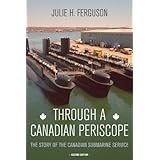
Product DetailsIt’s pretty common for authors to find cartons of unsold copies in their basements or their publisher’s warehouse. I take it you had the opposite problem with “Through a Canadian Periscope”?
Periscope sold two thirds of its print run in the first three months, and was out of print a couple years later. I attributed this to the book being selected for Books for Everyone just before Christmas 1995 — no social network or Internet campaigns in that era, just personal appearances on national radio and lots of positive reviews in the print media. I didn’t have a website until late-1996. How times have changed!

Who put on pressure for the second, updated edition, which just came out in March this year? Was it from your end, or from your publisher?
It was a joint endeavour — I’m fortunate to be close to my publisher, Kirk Howard, of Dundurn and also have had an ongoing relationship with the VP Sales and Marketing since 1993. Dundurn had published two other books of mine in 2006 and 2009, so I just told them about the submarine centenary over dinner one night. This is the huge advantage of building a strong and long relationship with your publisher and staff.

Were you anxious to do an update, in order to discuss the acquisition of the Victoria-class submarines and recent developments?
I was more eager to celebrate the submarine centenary in the only way that I could contribute. It was more that, than a desire to update Periscope. After all, I had another submarine book, Deeply Canadian, that detailed the acquisition of the Victorias after a ten day visit with the RN Upholder Sales Team in the UK. All I had to do was to discuss the activation, operational and maintenance processes with the RCN Submarine Force to get the books current. One benefit of second editions, however, is the ability to correct a few mistakes that became known after publication and another is the opportunity to restore the old images and add new ones.

What were the challenges in putting out the second edition?
None for Periscope. Also as all rights to Deeply Canadian had reverted back to me, I was free to make the changes to that book and publish it electronically using Kindle Direct Publishing, which I know how to do.

How have sales been?
Periscope: Don’t know until I sit down with the team at the end of June, and really we won’t know the details until after the centennial Submarine Week in August.
Deeply: I had 300 downloads of the digital second edition over Easter following a giveaway on Amazon and a huge promotion campaign on social media. I expected about 50 copies max, so was thrilled. This also caused a spike in Periscope sales apparently, but I don’t know the figures.
That was precisely my intention.
As an aside, this campaign also directly garnered invitations to do signings, media interviews, and presentations from the promotion of Deeply. A good result all round.

Julie Ferguson blogs at http://beaconlit.blogspot.com and is on Facebook, www.facebook.com/beaconliteraryservices. Her books are available on Amazon.ca.

Monday, May 12, 2014

HMCS Victoria to headline RIMPAC

RIMPAC 2014, a major international naval exercise, will kick off on June 26th this year and run through August 1st. Once again the RCN will be represented by HMCS Victoria and surface ships. Two years ago, during RIMPAC 2012, Victoria sank a decommissioned American ship with a live and highly successful torpedo firing.

Increased tensions at sea are current challenges for western navies. In the far east, the Peoples Liberation Army Navy is only one part of Chinese aggression toward her neighbours in the South China Sea. Meanwhile, in the Black Sea, Russia has increased its naval grip on the area with its annexation of the Crimean Peninsula.

Submarines were a major part of intelligence-gathering during the Cold War. Details of those activities are slowly surfacing, with books (eg Hunter Killers, by Iain Ballantyne) and a recent newspaper article in The Australian about the Royal Australian Navy's "secret submarines".There is no reason to think that submarine intelligence-gathering is no longer taking place.

Here is a look at an earlier post about Victoria's torpedo firing in 2012. Video footage of the target vessel sinking is here. 


Wednesday, May 7, 2014

The Battle of the Atlantic

Seventy-one years ago this month marked a turning point in the Battle of the Atlantic.
Slow Convoy 130 sailed from Halifax for Liverpool, escorted by ships of the Royal Canadian Navy. Up to that time, slow convoys had been easy pickings for U-boats of the Kriegsmarine, though less so with allied advances in equipment and technology.

A turnover of escort duty was duly made to a Mid-Ocean Escort Group, aided by long-range patrol aircraft. Three waves of German submarines were vectored onto SC 130, but every ship of the convoy made it safely across the Atlantic. German losses to aircraft and ships were at least three submarines with others damaged.

The month termed "Black May" by the German submariners was the pivotal point in World War II's longest-running battle.

HMCS Sackville, Canada's last surviving corvette, one of the many small ships of the RCN and RN that were a major force in the Battle of the Atlantic. Sackville is on display in Halifax and is a crucial piece in a major planned Battle of the Atlantic museum.

Wednesday, March 19, 2014

HMCS Okanagan--Best Boat Ever!

On a recent visit to Victoria I had a very happy reunion with Mike Dalzell, RCN Ret'd. Mike and I served together in HMCS Okanagan, the third of Canada's O-boats.

Mike has since mailed me one of the OK's commissioning booklets, shown at left. It is a real thrill to be able to, in a sense, renew acquaintances with the boat and crew.

Later this year, I'll be in Halifax to say hello to more of the gang from the "best boat ever"! (And it's not just me that says so.)

Monday, February 17, 2014

2014--The Year of the Submarine

photo courtesy RCN History & Heritage
There will be many functions relating to submarines in Canada this year. It was 100 years ago that the first Canadian boats appeared--purchased by none other than the premier of British Columbia, Sir Richard McBride. Celebratory events will take place in Victoria, Ottawa, Halifax and no doubt elsewhere.
I intend to be at the Victoria events, and also the AGM and conference scheduled by the Naval Association of Canada. The theme for the NAC event is "Submarines: Past, Present and Future". For more details, see the NAC site here.
The boat pictured here is HMCS Okanagan, in which I served in 1968-69. She was the last-commissioned of Canada's three O-boats, in service from the 1960's to the '90's.

Monday, February 10, 2014

Through a Canadian Periscope

Julie H. Ferguson's excellent Through a Canadian Periscope was first published in 1995 by Dundurn Press Limited. At long last they have done an eagerly-anticipated second edition, which is about to hit book stores and is presently available over the internet. The book is at once a history and a personal view, highlighted by Ms. Ferguson's extensive research and comprehensive interviews.
The second edition picks up where the first one left off, with the British totally fed up with the prevarications of the Canadian government over the possibility of purchasing diesel-electric submarines already built and waiting for buyers.
In the decade since, much has happened, both to the Canadian submarine service and the British boats. More comments here soon, but in the meantime, I will defer to Ms. Ferguson, when she speaks of the thread that has held the service together over its hundred year history:
"That thread is dedicated professionalism; for it is the men and women, not the boats, who are the true essence of the Canadian submarine service."

Monday, January 20, 2014

Where have all the sailors gone?

I was astounded to hear on CTV's national news channel last night that some 260-odd Canadian "soldiers" were in action in middle-eastern waters. Apparently they have taken over as crew of HMCS Toronto, and have distinguished themselves at sea, stopping and boarding a drug-smuggling vessel.
Shades of Paul Hellyer! The Royal Canadian Navy has, in the eyes of writers and readers of news broadcasts who should know better, disappeared into the "military". So, naturally, their men and women are "soldiers".


Wednesday, January 1, 2014

Another Salty HMCS Grilse Story

Here is another tale about life on board HMCS Grilse, Canada's first submarine in many years. It would have taken place in th 1960's, and is courtesy of retired Chief ERA Hal Zerbin. The daily rum issue was then a fact of life in Canadian navy ships and submarines. The "tot", as it was known, was highly prized by the seamen, some of whom would go to great lengths to get a little extra. 


“TOT” time on HMCS Grilse_-
It was a beautiful Sunday morning and the crew was enjoying a break from their demanding schedule, in their home port of Esquimalt. With only a reduced crew on board, and the rum now packaged in clean glass bottles, un-adulterated with the old wax and camel hair of Royal Navy days, it was not really much of a task to bring up a couple of bottles, with their measures and a little water for dilution purposes. This last being hardly necessary as the crew was now allowed to bring their mug  to the table already pre-filled with coke to enable them to enjoy their “Tot” in a much more civilized manner than in the past.
“Up-spirits" had been piped and myself, as the Duty Chief, and Lt. (Later Admiral), Jim Wood were guarding the rum, ready for issue. As luck would have it, the crew-member approaching the issue table was a well-known “shit-disturber” in navalese, who was always planning and preparing for another try at squeezing some additional rum from the issuing officer. He was never nasty about his efforts, but it was easy enough to see he ‘had a plan’ as his body language was a dead give-a-way.
*A word here about the construction of the Grilse. Built as the USS BURRFISH, one of the many USN ‘Fleet’ boats of the last war, she carried a large amount of diesel fuel when fully loaded, and her external Fuel Ballast tanks were the main storage place. To enable a closer watch on fuel consumption, these Fuel Ballast tanks had been fitted with pads of  small square-spindled valves, arranged in groups of 10, I believe, on the inboard side of the pressure hull, at approximately the centre point of each of the fuel tanks, both port and st’b’d. On the outboard side, inside each tank, small-gauge copper lines were fitted to each valve and led off to a different vertical location in the tank and fastened in place. Thus, if the tank was half full you could open the appropriate  valve inboard and if the tank was indeed at that level, fuel would come out, and, if not, water would come out, giving you a pretty accurate estimate of how much fuel was in that tank. It worked! Now every submariner knows how hard it is to stop diesel fuel from ‘weeping’ from any valve stems, and these little valves were no different and a constant source of diesel drips regardless of how tight you kept the little packing nuts. All submariners also know how short of storage space every submarine is, and the Grilse was no exception. The crew had found that if they kept their rum mugs stored close to the pressure hull they were quite conveniently situated, but, they had not counted on the diesel fuel weeping thru the valve stem packing and dripping into their carefully stowed rum mugs, thereby contaminating the mug, and making any contents, even rum, almost unfit to drink!
Back to the rum table-
Dan approached the issue table, fairly quivering with the thought that he was about to put one over on us, but we were ready for him. I poured him a good tot and poured it into his coke-ready mug and waited. Dan stepped back with his mug, then raised it for a tentative sip, then another, and another as a look of disgust appeared on his face. "It’s contaminated, Chief," he proclaimed loudly, "you try it and see," as he offered me his mug. I took his mug and managed to turn my back on Dan while I caught Lt. Woods’ eye and winked at him, then I raised the mug and had a good sip. Then I tuned to Dan and said, “Tastes all right to me, Dan”. Then I turned to Lt. Wood and passed the mug to him as I said, "You try it, sir!” Which he did, and had a second sip for good measure, then passed it back to me saying, "Tastes fine to me too Chief! You better try it again”. As I reached for the mug, Dan realized he had been caught out and  tore his mug out of my hand, saying “Gimme the G—Da—thing!” as he retired to a safe place to enjoy his contaminated and depleted tot, to the utter enjoyment of  the few onboard duty watch.
A little later , while I was enjoying my own tot in the Goat locker, I sent for Dan and poured him a drink in compensation for his loss! He was, after all, a good shipmate!!