Showing posts with label World War II. Show all posts

Friday, June 5, 2015

71 Years ago, D-Day Forces are Away

June 5th, 1944. The Allied armada is at sea, the gliders and troopcarrying aircraft are standing by. The weather on June 4th was bad enough that Nazi-occupied Europe's German forces are relaxed.
But June 6th is a full moon, and the weather may abate. Dwight Eisenhower makes his fateful decision--the invasion of France is on.
Aboard HMCS Kitchener, Canadian corvette, is Able Seaman Bill Cameron, aged 18.


Bill Cameron is one of hundreds of thousands of men and women involved in the largest amphibious attack in history. They are already at sea or are streaming toward the English ports to embark in the subsequent waves of attackers.

And each of them carries a message from Eisenhower (Bill's copy is reproduced at right).

In part it read:

"I have full confidence in your courage, devotion to duty and skill in battle. We will accept nothing less than full Victory!"

Here is one of several earlier posts about Bill and Kitchener .

Monday, May 11, 2015

Battle of the Atlantic Dinner

The 70th anniversary of the end of the longest battle of the Second World War, the Battle of the Atlantic, was celebrated at HMCS Discovery, Vancouver's reserve naval base, on May 2nd.

Present and pictured at left as Guest of Honour was The Honourable Judith Guichon, OBC, Lieutenant Governor of British Columbia. Brian Cook, president of the Naval Officers Association on BC was mess president for the occasion. At left, the Lieutenant Governor was presented with a history of Discovery.

To the right are John Horton (left), prominent marine artist, and Dr James Boutilier, Special Advisor to Commander MARPAC (Maritime Command Pacific, RCN). Dr. Boutilier spoke about the Battle of the Atlantic, and drew attention to the appalling losses suffered by the German U-boat fleet during the battle.

Saturday, April 18, 2015

From Snorting Steeds to Roaring Mechanical Monsters

Canada's cavalry regiments, which had distinguished themselves in World War I, had a major transition with the advent of the Second World War. At left is Lieutenant Austin Stanton of the 19th Alberta Dragoons, ca. 1937. (photo courtesy Jim Stanton.)


Only five years later,Lieutenant Stanton had made the big jump to the armoured corps, serving as Battle Adjutant of the Calgary Tanks when they landed at Dieppe in 1942.

The photo at right is of one of Lord Strathcona's Horse (RC)'s  Leopard II's, the German-built behemoths that saw service in Afghanistan. The Strathconas remained mounted until 1940, when they too made what had to be a wrenching conversion to turn in their horses and eventually become tankers.

Wednesday, March 5, 2014

Here is another shot taken in the Vancouver Island Military Museum. Not very good of me, but it is very good of my pal in the RCN square-rig whites, pre unification.
The museum, located in Nanaimo, is easy to find on Cameron St, just behind the casino.
A great and welcoming place to visit, it features areas that deal with the War of 1812, WW I and II, Korea, and the Cold War. Excellent displays of Canadian Army equipment, RCN ships and RCAF aircraft.
Highly recommended!

Thursday, May 23, 2013

Canadian Naval History, courtesy of the National Film Board of Canada

HMCS Bonaventure
Thanks to a mention in the newsletter of a naval organization, I saw a reference to a 1960 National Film Board movie. Fifty-eight minutes in length, An Enduring Tradition presents in a remarkably cogent fashion the history of the Royal Canadian Navy up to 1960. Aircraft carriers, cruisers, destroyers, frigates, corvettes, submarines, minesweepers, auxilliaries: they are all there.
RCN names to conjure with: Charles Kingsmill, Walter Hose, Harry DeWolf, and many others. "Heart of Oak" and "Roll Along Wavy Navy". Shiploads full of inherited memories, and real ones, diminished by time, stirred up.

Saturday, May 18, 2013

"Facta Non Verba: A History of the Fort Garry Horse"

In an earlier post, I mentioned attending the museum of the Fort Garry Horse, the militia regiment garrisoned in Winnipeg. During a visit to the FGH museum our guide was Chief Warrant Officer Gordon T. Crossley, one of the authors of "Facta Non Verba". CWO Crossley's coauthor is Michael R. McNorgan, an armoured corps veteran and a well-published historian. Between them they have written a lively, colourful account of a proud regiment.
I have been interested in the regiment for some years, as it was one of the three regiments in the Canadian Cavalry Brigade in the Great War, and part of the milieu for my novel, "Soldier of the Horse". The chapter on the Great War is excellent, as are the others, covering as they do the regiment's origins, its participation in the two world wars, the cold war, and the modern era.
 Also included are nominal rolls from early days onward, which will be of particular interest to families of veterans, and honours awarded to personnel and the regiment itself.
"Facta Non Verba" is an excellent, easy read, with a plethora of maps, photos, and diagrams. It is highly recommended for anyone interested in Canadian history, the Fort Garrys, and the evolution of this proud regiment.
The book is available through the Fort Garry Horse Kit Shop.

Thursday, May 16, 2013

Royal Navy Submarine Museum HMS Alliance

The Royal Navy's only remaining World War II vintage submarine, HMSAlliance, is reunited with her periscopes. The boat is high and dry alongside Haslar Creek, near Gosport, England, her home base for many years. Alliance is now a museum piece, slated for opening to the public in 2014. A good year for submariners, especially Canadian ones, given 2014 is the centenary of submarines in Canada.
The photo is courtesy of the RN Submarine Museum. For more on the Alliance look here.

Friday, May 3, 2013

World War II's Longest Fight--The Battle of the Atlantic

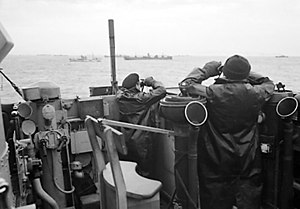
Officers on the bridge.jpg
The bridge of a British escort

The Battle of the Atlantic ran from the outbreak of World War II in 1939 until the German surrender in 1945. It pitted the Germans on one side against primarily the British and Canadian navies on the other. At stake was the blockade of German ports by the Allies, and the blockade by the Germans of shipping to the UK and Russia. It was a near-run thing for the Allies, with the balance of success shifting one way or the other with technical advances often a determining factor. Radar, air cover, and code-breaking all played a part in the Allied victory.
But at the heart of the victory were the merchantmen running the deadly U-boat wolfpacks, escorted by the little ships of the Royal Canadian Navy and the Royal Navy.
There are fewer survivors of the longest battle of the war still with us every year. This weekend is dedicated to them. Church ceremonies, dinners, naval and Legion observances are the order of the day. Please attend, or spare a thought for the men and women who defended us all through those dark days. (photo courtesy Wikipedia)